


.avif)
Vermont's Complete Year-Round Home Pest Calendar: A Natural Approach to Pest Defense
- surremorinsights
- Dec 1, 2025
- 17 min read


Vermont homeowners face a predictable parade of pests driven by the state's distinct four seasons—cold winters that push rodents indoors, humid summers that breed mosquitoes and ticks, and those late-fall invasions of stink bugs clustering on sun-warmed siding. Understanding when each pest becomes problematic is the first step toward effective, chemical-free control. This comprehensive month-by-month guide combines Vermont's unique climate patterns, regional differences from the Champlain Valley to the Northeast Kingdom, and proven Integrated Pest Management (IPM) strategies to help you stay ahead of seasonal invaders.
Whether you're in Burlington watching carpenter ants emerge with the April thaw or in Bennington dealing with earlier tick activity thanks to southern Vermont's milder climate, timing matters. Prevention-focused, botanical, and natural approaches work best when applied proactively—before populations explode.
January through February: Winter's quiet demands indoor vigilance
Vermont's coldest months bring average lows of 8-15°F statewide, with the Northeast Kingdom around St. Johnsbury and Newport regularly dipping below zero. Most insects are dormant, but the pests that matter most right now are already inside your walls.

Mice and rats remain highly active throughout winter in Vermont homes, particularly in older structures with stone foundations common in towns like Woodstock, Middlebury, and Brattleboro. These rodents don't hibernate—they breed continuously when sheltered with food access. Signs include droppings near food storage areas, gnaw marks on packaging, and scratching sounds in walls at night. The IPM approach focuses on exclusion: seal gaps larger than 1/4 inch with steel wool and caulk, and deploy snap traps along walls where travel paths are evident.
Cluster flies, Asian lady beetles, and brown marmorated stink bugs remain dormant in wall voids and attics but may emerge on unusually warm, sunny days—especially in south-facing rooms in Shelburne, Charlotte, or other Champlain Valley communities where Lake Champlain's moderating effect creates slightly milder microclimates. If you're seeing large, slow-moving flies at windows in February, they're exiting overwintering sites, not new invaders. Vacuum removal is the most practical natural control; avoid crushing stink bugs indoors, as their defensive odor persists.
Carpenter ants appearing indoors during January or February signal a serious problem: a nest exists inside the heated portion of your home. In unheated structures, carpenter ants remain dormant until spring. Indoor winter sightings—particularly large winged swarmers—indicate moisture-damaged wood requiring professional inspection. Check areas around dishwashers, bathrooms, and any location where leaks may have occurred.
Proactive winter tasks: Inspect your pantry for Indian meal moths and flour beetles, which breed year-round indoors. Store all dry goods in airtight glass or hard plastic containers. Bay leaves placed on shelves naturally deter egg-laying moths. This is also ideal time for exclusion work—sealing foundation cracks and gaps around utility penetrations before spring emergence begins.
March: The earliest invaders stir as Vermont thaws
March marks the transition from dormancy to activity as average temperatures climb to 38-42°F across Vermont. This is when proactive homeowners gain their greatest advantage.
Carpenter ants begin emerging from their dormant state as temperatures warm, with activity noticeable first in the warmer Champlain Valley (Burlington, Vergennes, South Burlington) and southern Vermont (Bennington, Manchester, Brattleboro). By late March, homeowners throughout the state may notice these large black ants foraging indoors, particularly at night between 10 PM and 2 AM. The IPM approach emphasizes moisture control—carpenter ants excavate damp, decaying wood rather than consuming it. Fix any roof leaks, address condensation issues, and ensure proper ventilation in crawlspaces.
Pavement ants may appear in heated buildings, especially commercial structures and homes with radiant floor heating. These small dark ants nest beneath foundations and sidewalks, emerging indoors when their food stores deplete. Boric acid mixed with sugar creates an effective slow-acting bait that workers carry back to colonies.

Termite swarmers can emerge as early as late March if colonies exist within heated structures, though peak swarming occurs April through May. Unlike carpenter ants, termites consume wood directly and cause structural damage. Watch for discarded wings near windows and mud tubes on foundation walls.
Blacklegged (deer) ticks become active any time temperatures rise above freezing. Vermont has the second-highest Lyme disease incidence rate in the nation, with approximately 57% of adult blacklegged ticks carrying Borrelia burgdorferi. Southern counties—Bennington, Windham, Windsor, and Rutland—show the highest infection rates, while the Northeast Kingdom currently has fewer established tick populations. Begin tick-safe landscaping now: clear leaf litter from lawn edges, create a 3-foot barrier of wood chips between lawn and wooded areas, and keep grass short.

Regional timing note: Pest emergence in the Green Mountains around Stowe, Waitsfield, and Warren typically runs 2-3 weeks behind the Champlain Valley due to higher elevation and colder temperatures.
April: Spring pest season arrives in full force
April brings Vermont's true pest awakening, with average highs reaching 52-56°F and last frost dates approaching in southern and Champlain Valley regions. This month demands attention.
Carpenter ant swarming season officially begins, with winged reproductives emerging on warm days following spring rains. Swarms typically occur during afternoon hours. Finding swarmers indoors confirms an interior nest requiring treatment. Natural control options include diatomaceous earth applied to cracks and entry points—this food-grade powder works as a desiccant, dehydrating insects through direct contact. For colony elimination, bait stations using boric acid are more effective than contact killers, as workers share food with the queen through trophallaxis.
Termite swarming peaks in April and May across Vermont. Eastern subterranean termites—the species present in our region—produce winged swarmers that emerge from soil on warm, humid days. Unlike carpenter ants (which have pinched waists and bent antennae), termite swarmers have straight, beaded antennae and broad waists. Finding termites requires professional assessment; natural prevention focuses on moisture management and maintaining separation between wood and soil around foundations.
Tick activity accelerates dramatically, with nymphal blacklegged ticks (the life stage most likely to transmit Lyme disease) beginning their peak season. Nymphs are poppy-seed-sized and easily overlooked during outdoor activities. For yard treatment, products containing permethrin—derived from chrysanthemum flowers—can be applied to clothing and remain effective through 70+ washes. Cedar oil provides an OMRI-listed option safe for children and pets but requires weekly reapplication.

Overwintering pests exit buildings throughout April. Cluster flies, stink bugs, and Asian lady beetles become increasingly active at windows as wall voids warm, seeking to return outdoors. This is normal behavior—these insects are leaving, not entering. Continued vacuum removal is the appropriate response. Sealing entry points now is too late for this season but note problem areas for August attention.
Wasp and hornet queens emerge from overwintering sites and begin establishing new colonies alone. Nests are small (golf ball-sized) and queens are vulnerable at this stage. If you locate early nests in accessible areas like under eaves in Burlington, Rutland, or Montpelier, removal is straightforward before workers emerge.
May: Peak emergence and Lyme disease prevention priority
May is Vermont's most critical month for pest prevention, with average temperatures reaching 64-69°F and the last frost dates passing throughout most of the state (May 5-10 in Champlain Valley; May 25-June 5 in mountain regions and the Northeast Kingdom).
Tick season reaches its first peak as nymph activity explodes from mid-May through June—this is Vermont's highest Lyme disease risk period. The Vermont Department of Health reports that approximately 24% of nymphal ticks test positive for Lyme bacteria. Nymphs feed aggressively to molt into adults, and their small size makes detection difficult. IPM tick control emphasizes habitat modification: maintain a dry, sunny buffer zone around play areas, remove leaf litter and brush at lawn edges, and keep grass mowed short. Consider permethrin-treated clothing for hiking and outdoor work. Tick tubes—permethrin-treated cotton that mice carry into their nests—reduce the tick population's primary host reservoir.
Black fly season begins statewide, particularly intense in the Green Mountains around Stowe and Sugarbush, and along rivers and streams throughout central Vermont near Waterbury and Northfield. Bti (Bacillus thuringiensis israelensis)—a naturally occurring soil bacterium—is the gold standard for black fly larval control in streams and is used extensively by Vermont municipalities. For personal protection, long sleeves and netting provide the most reliable defense.
Mosquito season launches in early May; this is the optimal time to begin source reduction and treatment. Mosquitoes can develop from egg to adult in as little as 7 days in warm water. Eliminate all standing water: empty containers weekly, clean gutters, change birdbath water, and stock ornamental ponds with mosquitofish. Bti products (Mosquito Dunks and Bits) applied to standing water that cannot be eliminated provide effective, non-toxic larval control that doesn't harm fish, birds, or beneficial insects.

Carpenter ant and pavement ant activity peaks, with both species foraging heavily to support growing colonies. Trail following—observing where ants travel—helps identify entry points and potential nest locations. Seal cracks with caulk and apply diatomaceous earth in wall voids accessed through electrical outlets (turn off power first).
Termite swarming continues through May. Swarms typically emerge during morning hours on warm, humid days following rain. Document any swarmer activity and preserve specimens (they help confirm species identification) for professional assessment.
Town-specific considerations: Burlington and the Champlain Valley enter full pest season 2-3 weeks before mountain communities. Newport and Lyndonville in the Northeast Kingdom may not see peak emergence until late May or early June.
June: Summer pest populations build across Vermont
June brings peak growing season conditions with average highs of 73-78°F and the highest humidity of the year beginning to build. Vermont's approximately 68% average annual humidity creates ideal conditions for many pest species.
Tick activity remains elevated, though the nymphal peak begins declining toward month's end. Continue diligent tick checks after outdoor activity, focusing on warm, moist areas of the body. Landscaping installed in April and May now pays dividends—tick populations are significantly lower in maintained yards with dry buffer zones.
Mosquito populations reach full summer levels. Vermont has 47 documented mosquito species, with surveillance conducted at approximately 100 trap sites in 82 towns. Disease risk increases through summer, with West Nile virus, Eastern Equine Encephalitis (EEE), and Jamestown Canyon virus all present in Vermont mosquitoes. Natural adult control includes oil of lemon eucalyptus (EPA-registered and effective) and citronella (requires frequent reapplication). For yard treatment, IPM focuses on continued source reduction rather than broad-spectrum adulticiding, which harms beneficial insects.
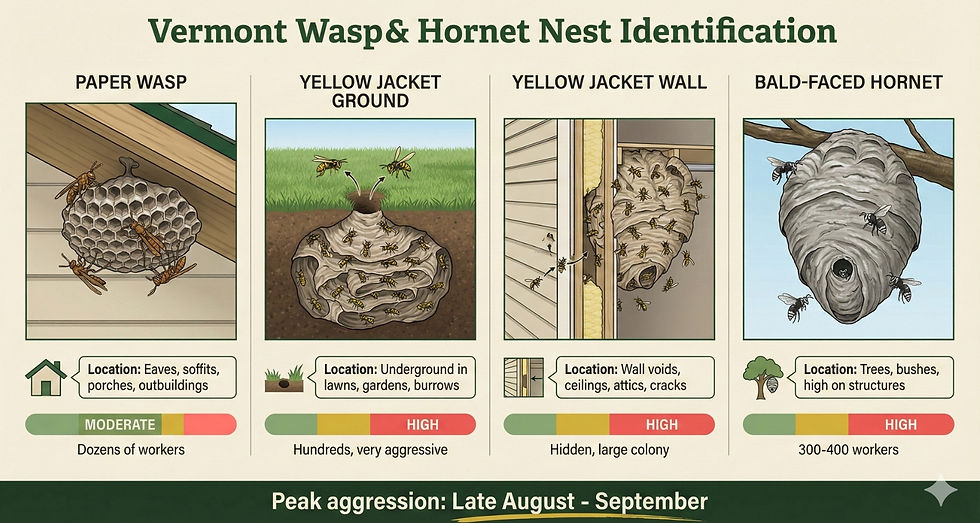
Wasp and hornet colonies grow rapidly as workers emerge and nest construction accelerates. By June, nests may contain dozens of workers and become more visible in eaves, soffit voids, and trees throughout Middlebury, Colchester, Essex Junction, and communities statewide. Nests are not yet at peak size; removal remains relatively straightforward for accessible locations. Botanical sprays using peppermint oil work as contact killers—peppermint blocks octopamine receptors unique to insects, causing rapid knockdown. Treatment is most effective at night when all workers are present.
Carpenter ants reach peak foraging activity, primarily during nighttime hours. If you're seeing carpenter ants regularly indoors during June, professional inspection is warranted to locate and eliminate the colony before summer damage accumulates.
Bed bug season begins. Though bed bugs are active year-round (unaffected by outdoor temperatures), detection and complaints increase dramatically through summer travel season. Bed bug reproduction accelerates in warmer temperatures, with lifecycle as short as 3 weeks versus several months in cooler conditions. Before traveling, inspect hotel mattress seams and headboards; upon returning, launder all clothing on high heat and inspect luggage outdoors.
Spider activity increases throughout Vermont homes, with house spiders, wolf spiders, and jumping spiders all common. Most Vermont spiders are harmless (black widows and brown recluses are rare). Spiders indicate the presence of prey insects—addressing other pest problems often reduces spider populations naturally. Peppermint oil spray (10-15 drops per ounce of water with dish soap as emulsifier) has been scientifically validated to repel several spider species.
July: Peak summer demands peak vigilance
July is Vermont's warmest month, with average highs of 78-82°F statewide and morning humidity regularly exceeding 80%. Pest activity reaches annual peaks for many species.
Mosquito-borne disease risk climbs as infected mosquito populations build through the season. The Vermont Department of Health conducts surveillance from June through mid-October, with the highest percentage of infected mosquitoes typically detected in late August through mid-September. Continue source reduction religiously—a single overlooked container can produce hundreds of mosquitoes weekly. For properties near wetlands in Vergennes, Swanton, or Lake Champlain shoreline communities, professional Bti applications may be necessary.
Yellow jacket and wasp colonies expand rapidly, with populations growing from dozens to hundreds of workers. Ground-nesting yellow jackets become a particular hazard during lawn mowing and gardening activities. Paper wasp nests under eaves reach noticeable size. Hornet colonies (including bald-faced hornets, common throughout Vermont) may contain 300-400 workers by late July. Aggression increases as colonies mature. If nests don't pose immediate danger, consider leaving them—wasps are beneficial predators that control aphids, caterpillars, and even mosquitoes.
Carpenter ant damage potential is highest during mid-summer when colonies are large and actively excavating galleries. Look for frass (sawdust-like debris containing wood fragments and insect body parts) below wooden structures, hollow-sounding wood, and trails of ants traveling to and from food sources.
Deer flies peak in July, particularly in areas near water throughout the Green Mountains and along Lake Champlain. Unlike horse flies, deer flies attack the head and shoulders persistently. Physical barriers (hats, netting) provide the most reliable protection.

Pantry pest activity increases with warmer indoor temperatures. Indian meal moths can complete their lifecycle in as little as 25-40 days under optimal conditions. Inspect stored grains, cereals, dried fruits, nuts, and pet food for webbing or small larvae. Pheromone traps help monitor moth populations but don't eliminate infestations—remove contaminated products and thoroughly clean storage areas.
August: Late summer transitions begin
August maintains high temperatures (average highs 77-81°F) but marks the beginning of critical transitions as pests prepare for fall and winter.
Yellow jacket and wasp aggression peaks in late August through September. Natural food sources (aphid honeydew, caterpillars) decline as summer wanes, driving yellow jackets to aggressively scavenge human food at picnics, outdoor dining areas, and garbage receptacles. Nests are at maximum size with 300-800+ workers. This is Vermont's peak sting season—outdoor events in Manchester, Stowe, and Killington (popular late-summer destinations) require vigilance. Natural trap designs using sugar water or meat attractants can reduce local populations but should be placed away from gathering areas, as traps attract wasps from surrounding areas.

Overwintering pest behavior begins. Brown marmorated stink bugs, cluster flies, and Asian lady beetles start searching for protected overwintering sites. On warm, sunny days in late August, these insects congregate on south and southwest-facing walls—particularly on light-colored siding that absorbs heat. This is the critical window for exclusion work: seal cracks around windows, doors, and utility penetrations with silicone caulk; install door sweeps; repair damaged screens; and seal gaps in soffits before temperatures drop. Once inside wall voids, these pests cannot be effectively controlled.
Bed bug reports peak in August and September, coinciding with post-vacation returns and approaching college move-in season. Heat treatment remains the most effective natural approach for confirmed infestations—professional whole-house treatment raises temperatures above 120°F for 6-8 hours, killing all life stages including eggs. Diatomaceous earth applied to cracks and mattress seams provides supplementary control but is insufficient alone for active infestations.
Tick activity begins its second annual peak as adult blacklegged ticks become active. This coincides with hunting season preparation—hunters throughout Vermont should treat clothing with permethrin and conduct thorough tick checks after scouting trips.
Regional note: Expect pest behavior to shift earlier in northern regions. By late August, homes in the Northeast Kingdom around Newport and Island Pond may already be seeing significant overwintering pest pressure.
September: Fall invaders demand action
September brings rapid temperature decline (average highs drop to 68-72°F) and the most critical pest management month for Vermont homeowners.
Stink bugs, cluster flies, and Asian lady beetles enter homes in force. Peak invasion occurs as nighttime temperatures drop, typically through mid-October. These insects are strongly attracted to warmth and will exploit any opening 1/4 inch or larger. Asian lady beetles—often called "Halloween beetles" for their October peak—can accumulate in tens of thousands within wall voids and attics of homes throughout Burlington, Rutland, Barre, and virtually every Vermont community. Unlike native ladybugs, Asian lady beetles can bite and release a foul-smelling yellowish fluid that stains surfaces.

If exclusion wasn't completed in August, do it NOW. Focus on:
South and west-facing exterior walls (warmest sides)
Around window and door frames
Fascia boards and behind chimney flashing
Utility penetrations (cable, phone, electrical)
Soffit vents (install fine mesh)
Foundation cracks
Mouse and rat entry begins with the first cold spell, typically mid-to-late September in Vermont. Rodents seek food, water, and warmth as crops are harvested and temperatures drop. Mast years—when oak, beech, and other trees overproduce nuts (occurring every 3-5 years)—create population booms that intensify fall invasion pressure. Seal all openings 1/4 inch or larger with steel wool and caulk, install door sweeps, and deploy snap traps along walls in basements, attics, and garages. Peppermint oil may temporarily mask pheromone trails but is not effective as standalone rodent control.
Yellow jacket aggression remains extreme through September as colonies reach maximum population and natural food becomes scarce. Nests die off with killing frost, typically late September in mountain regions and October in the Champlain Valley. Only newly-mated queens survive to overwinter.
Tick activity reaches its second annual peak in September and October as adult blacklegged ticks seek hosts before winter. This peak coincides with hunting season—Vermont hunters should be particularly vigilant. Ticks remain active any time temperatures exceed freezing; Vermont health officials now advise that "tick season is 12 months."
October: Completing fall preparation before winter arrives
October completes fall transition, with average temperatures dropping to 55-60°F for highs and first frost occurring throughout most of Vermont (October 3-8 in Champlain Valley; September 15-25 in mountains and Northeast Kingdom).
Mouse entry peaks in October as Vermont homeowners report peak rodent sightings indoors. Mice can squeeze through holes the size of a dime; rats require only a half-inch opening. Priority exclusion points include:
Where utility pipes and wires enter the structure
Foundation-to-sill plate junctions
Gaps around garage doors
Weep holes in masonry (install fine mesh covers)
Where old stone foundations meet wood sills

The IPM approach relies primarily on exclusion (preventing entry) combined with trapping (addressing existing populations). Multiple-catch traps can capture 12+ mice without pesticides. Electric traps provide quick, humane kills. For persistent problems, professional assessment may identify entry points homeowners overlook.
Asian lady beetle invasion peaks around Halloween. Vacuum removal remains the most practical control for beetles already indoors. Avoid crushing them—the defensive fluid stains and smells persist. Vermont's 42 recorded ladybeetle species include 35 natives being displaced by this aggressive Asian import.
Adult tick activity continues. Blacklegged tick adults are most active October through November, coinciding with deer hunting season (deer are primary hosts for adult ticks). Hunters returning from Vermont's forests should check thoroughly and dry clothing on high heat for 10+ minutes.
Cluster flies settle into overwintering sites. These larger-than-houseflies pests (identified by golden hairs on their thorax) become dormant in wall voids and attics, remaining until February or March warmth activates them. If you haven't sealed entry points, you'll live with these slow-moving flies throughout late winter and early spring.
Final wasp nest season ends with hard frost. Remove old paper wasp nests now (they won't be reused next year) and note locations for early spring monitoring.
Proactive fall checklist: Complete all exterior exclusion work, trim vegetation away from structure, remove leaf litter near foundations, store firewood away from buildings, and clean gutters to eliminate mosquito habitat for next spring.
November: Transition to indoor focus
November brings Vermont's first significant snowfall and freezing temperatures (average lows 28-32°F), transitioning pest management focus entirely indoors.
Rodent pressure intensifies as temperatures drop. Mice and rats that entered earlier are now established, breeding, and expanding populations inside homes. Signs include droppings (mouse droppings are rice-grain-sized; rat droppings are larger and capsule-shaped), gnaw marks on food packaging, and evidence of nesting (shredded paper, fabric, insulation). Continue trapping and address any missed entry points. In rural Vermont and communities near agricultural areas like Addison, Orwell, and Shoreham, fall harvest brings elevated rodent activity that may persist into winter.
Tick activity continues until hard freeze. Adult blacklegged ticks remain active any time temperatures exceed freezing—even November and December can bring exposure during unseasonably warm periods. Vermont health officials emphasize year-round vigilance.
Bed bug risk increases with Thanksgiving travel. Inspect accommodations when visiting family, and check luggage before bringing it inside upon return. Heat treatment (clothes dryer on high for 30+ minutes) kills all bed bug life stages.
Overwintering pests are dormant but established in wall voids. Occasional warm days may activate cluster flies and stink bugs, causing them to appear at windows. This continues through winter and into spring—there is no practical control once they're inside walls beyond waiting for spring departure.
Indoor humidity and pantry pests: As heating systems run, indoor humidity drops. This actually benefits pest control—many insects require higher humidity to thrive. However, pantry pests remain active in kitchen storage areas. With holiday baking season arriving, inspect stored flour, sugar, spices, and dried fruits. Pheromone traps help monitor for Indian meal moth activity.
December: Winter vigilance and planning ahead
December brings full winter conditions to Vermont (average lows 16-20°F) with most outdoor pests dormant. Indoor focus continues.
Mice and rats represent the primary concern. Winter breeding continues if food and water are available. Signs of established populations include grease marks along walls (from repeated travel routes), ammonia odor in enclosed areas, and visual sightings (mice are curious and may be seen foraging; rats are more cautious). Maintain trapping efforts and ensure food storage is secure. Remove bird feeders during winter or place them far from structures—fallen seed attracts rodents.
Holiday travel brings bed bug risk. College students returning home may unknowingly transport bed bugs from dormitory infestations. Inspect luggage, and launder all clothing from travel on high heat.
Pantry pest monitoring is essential during holiday baking season. Products purchased in bulk or stored long-term are highest risk. If moths are seen flying near stored products, conduct thorough inspection—remove all items, vacuum shelves completely, wash with vinegar solution, and dispose of any contaminated products. Store replacements in airtight glass containers.
Carpenter ants appearing indoors in December confirm an interior nest in heated portions of the structure. This warrants professional inspection to locate moisture-damaged wood and eliminate the colony.
Planning for next year: December is ideal for scheduling professional inspection and developing a year-round pest management plan. Review this year's pest challenges—which species were problematic? Where were entry points discovered? What exclusion work remains incomplete? A proactive IPM approach emphasizes prevention over reaction, addressing conditions that attract pests rather than waiting for infestations to develop.
Vermont's regional pest patterns at a glance
Vermont's climate varies significantly across the state, affecting pest timing and pressure. Understanding your region helps prioritize prevention efforts.
Champlain Valley (Burlington, Shelburne, Vergennes, Middlebury, South Burlington, Essex Junction, Winooski, Charlotte, Colchester): Lake Champlain moderates temperatures, creating Vermont's longest growing season (155-182 days) and mildest winters. Expect pest emergence 2-3 weeks earlier than mountain regions. USDA zones 5a-5b, with some areas approaching zone 6a. Higher mosquito pressure near lake and wetlands. Earliest carpenter ant activity statewide.

Southern Vermont (Bennington, Brattleboro, Manchester, Wilmington, Dover, Arlington): Vermont's mildest overall climate with earliest spring arrival. USDA zones 5a-5b with zone 6a emerging in some areas. Highest Lyme disease incidence rates. Longest tick season statewide. Earlier spring pest emergence allows more proactive prevention window. Highest annual precipitation (44-48 inches) supports robust pest populations.
Green Mountains (Stowe, Killington, Waitsfield, Warren, Sugarbush area): Higher elevation brings 5-10°F colder temperatures and significantly shorter growing season (100-130 days). Heavy snowfall (100-325 inches annually) provides insulation for overwintering pests. Severe black fly season in May-June. Delayed pest emergence—schedule prevention efforts 2-3 weeks later than valley communities.
Northeast Kingdom (St. Johnsbury, Newport, Lyndonville, Barton, Orleans, Island Pond): Vermont's coldest region with shortest pest season. USDA zones 4a-4b. Last spring frost may not occur until June 10; first fall frost as early as September 10. Shorter pest season but intense mid-summer activity. Currently has fewest established tick populations but this is changing with warming climate. Coldest winters provide natural pest mortality.
Central Vermont (Montpelier, Barre, Waterbury, Northfield, Rochester): Moderate climate transitioning from zone 4b to 5a. Valley locations vary significantly from hillsides. River valleys prone to fog and humidity supporting black fly and mosquito breeding. State capital area experiences urban heat island effect supporting slightly longer pest season.
The natural-first approach to Vermont pest defense
Effective pest management doesn't require harsh chemicals. Integrated Pest Management—the approach used by Vermont's leading pest control professionals—prioritizes prevention, monitoring, and targeted intervention using the least-toxic methods effective for each situation.

Core IPM principles for Vermont homeowners:
Prevention first: Exclusion (sealing entry points), sanitation (removing food sources), and habitat modification (eliminating moisture and harborage) prevent most pest problems
Monitor and identify: Knowing exactly what pest you're facing ensures appropriate response
Target interventions: When treatment is necessary, botanical and biological options often match or exceed conventional pesticide effectiveness
Time treatments strategically: Understanding pest biology allows intervention at vulnerable life stages

Proven natural products for Vermont pests: Diatomaceous earth works as a mechanical insecticide through desiccation. Boric acid baits exploit ant colony behavior for whole-nest elimination. Bti larvicides provide targeted mosquito control without harming beneficial insects. Peppermint and clove essential oils have scientific validation for repelling wasps and spiders. Permethrin (derived from chrysanthemum flowers) offers powerful tick protection when applied to clothing. Heat treatment eliminates bed bugs without chemicals. Physical exclusion—caulk, steel wool, hardware cloth—remains the single most effective rodent control method.


Comments